Sub-Study · TrialComplete · T-Systems ICT India · Oct 2025
Study Users:
safe user assignment
High-frequency, high-risk admin task. Wrong role in a clinical trial means a compliance failure. This is the redesign that made the workflow trustworthy.
modelled
in task steps
user is toggled off
Blueprint
At a glance
Study Users sat four levels deep, and admins avoided the include toggle because they believed it deleted role assignments. It never did, but the system never said so.
Led UX end to end, defining system behaviour and every interaction state with the Product Owner before any interface was drawn.
- Made inclusion an explicit state, so an admin can answer "is this person in the study" without reading carefully.
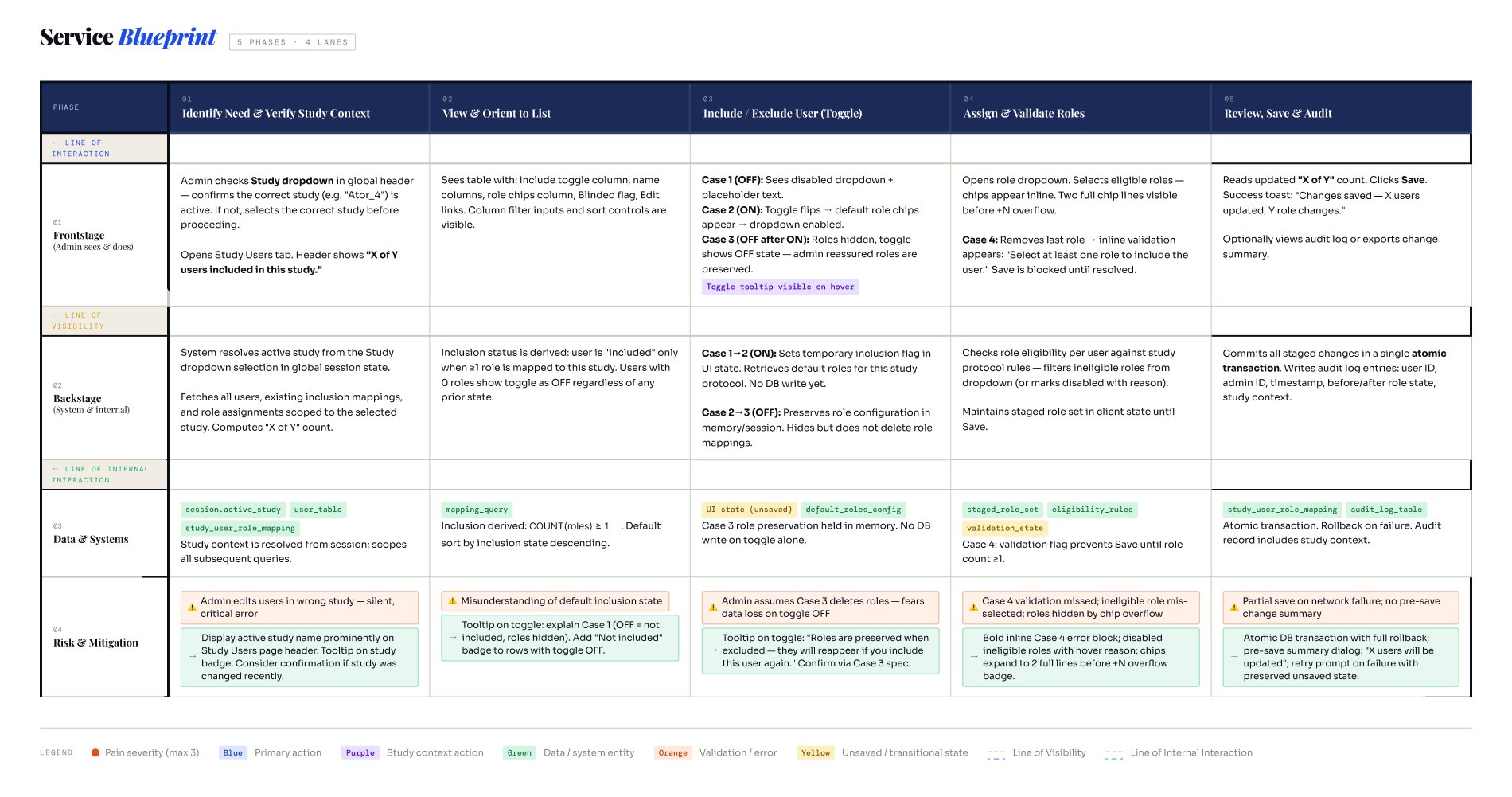
- Preserved roles on toggle off rather than deleting them, which is the change that fixed the trust problem.
- Moved roles inline as chips and added bulk assignment, replacing one modal per user.
An estimated 50 to 70% fewer task steps for multi user scenarios, and admins stopped avoiding the toggle.
The Problem
What was
actually broken.
Study Users was buried four levels deep, and when you got there the interface made a straightforward task harder than it needed to be.
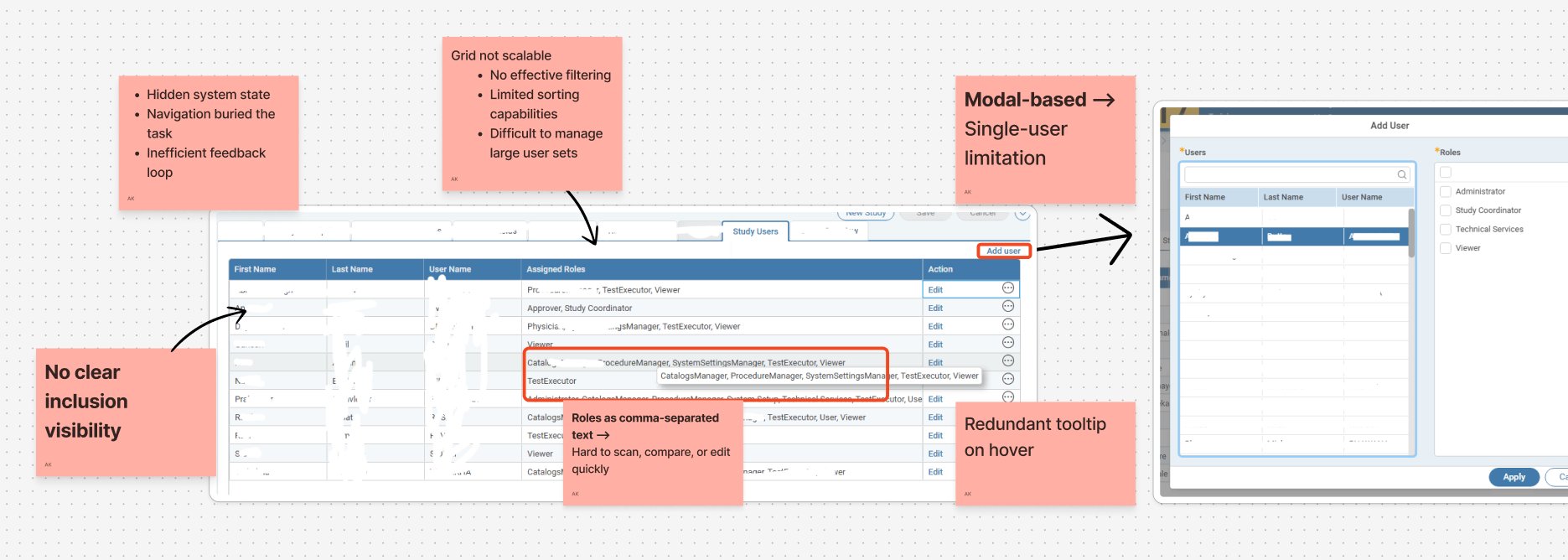
No clear "included vs not included" state
All users sat in one list. Admins couldn't answer "is this person in the study" without reading carefully.
Adding users and assigning roles felt disconnected
Admins think "add Bob as Study Coordinator". The system forced two steps with nothing linking them.
One user at a time, every time
Every addition opened a modal, once per user. For studies with 15 or more people this was genuinely slow.
Roles as comma-separated text
"CatalogsManager, ProcedureManager, SystemSettingsManager, TestExecutor, Viewer" is hard to scan, with no inline editing.
Admins thought the toggle deleted roles
It didn't, but the system never said so. The result was hesitation, avoided changes, and support escalations.
Key Insight
One decision,
not two steps.
Inclusion and role assignment aren't separate tasks. They're one mental action, and the system needed to reflect that.
Never delete silently. Always preserve.
My Role
What I did.
The Solution
Toggle inclusion with
inline roles.
Six decisions changed how the workflow felt.
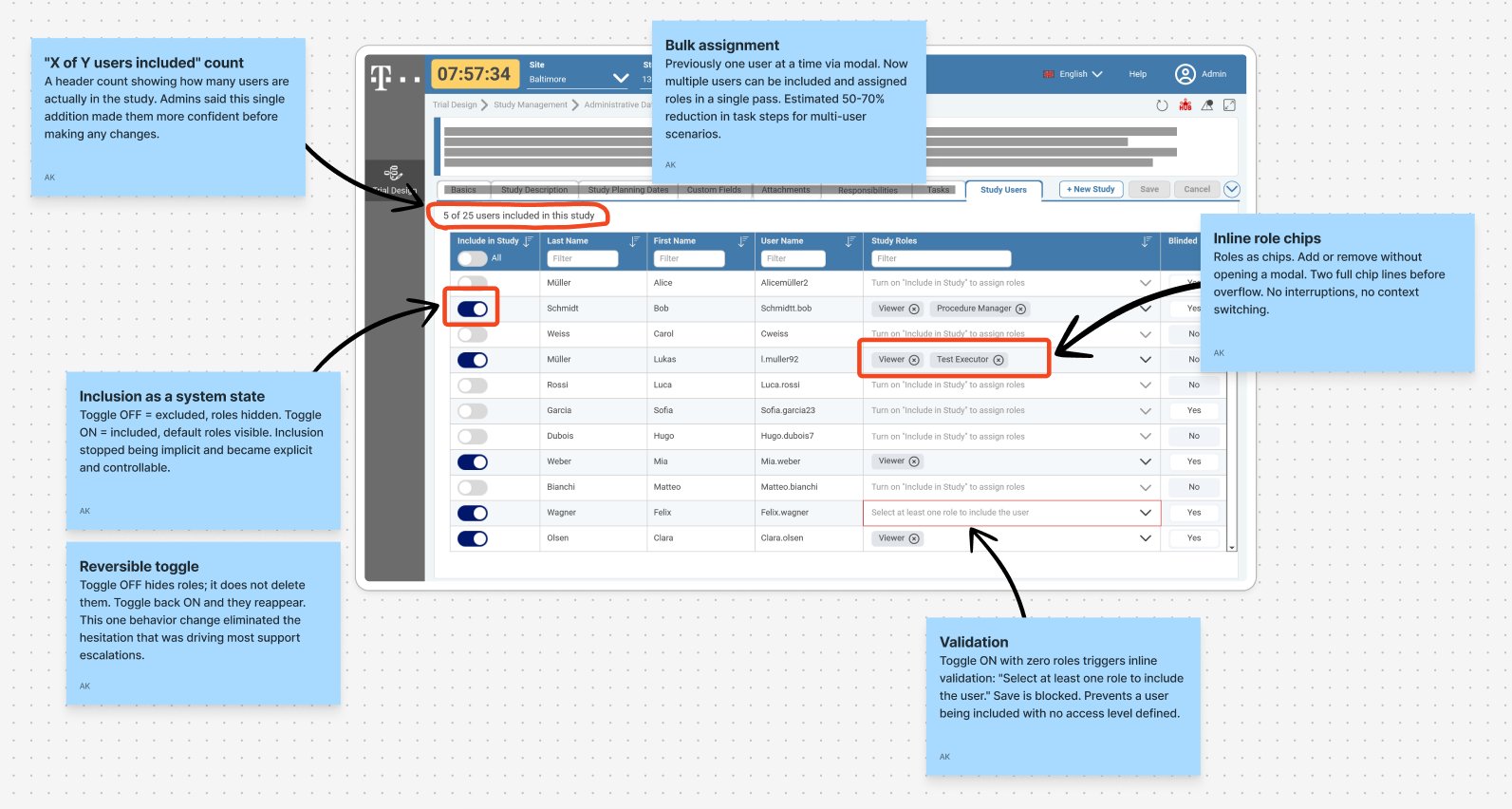
- Inline role chips. Add or remove roles in the row, no modal required
- Bulk assignment. Several users in one interaction, previously one per modal
- "5 of 25 users included". Admins said the header count alone made them more confident
The other three decisions are all toggle behaviour, set out case by case below.
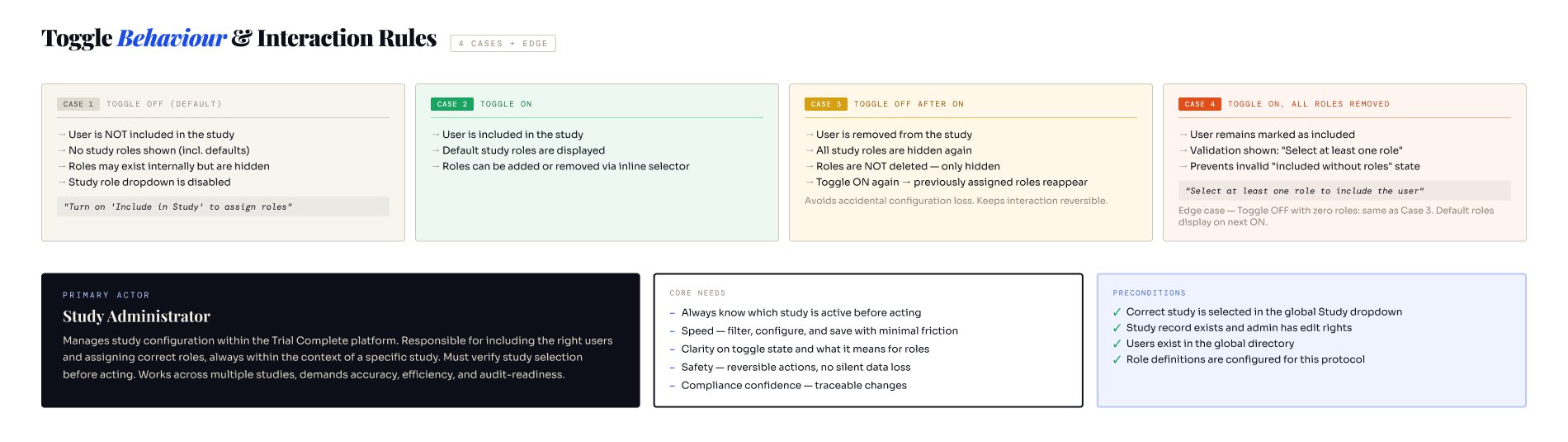
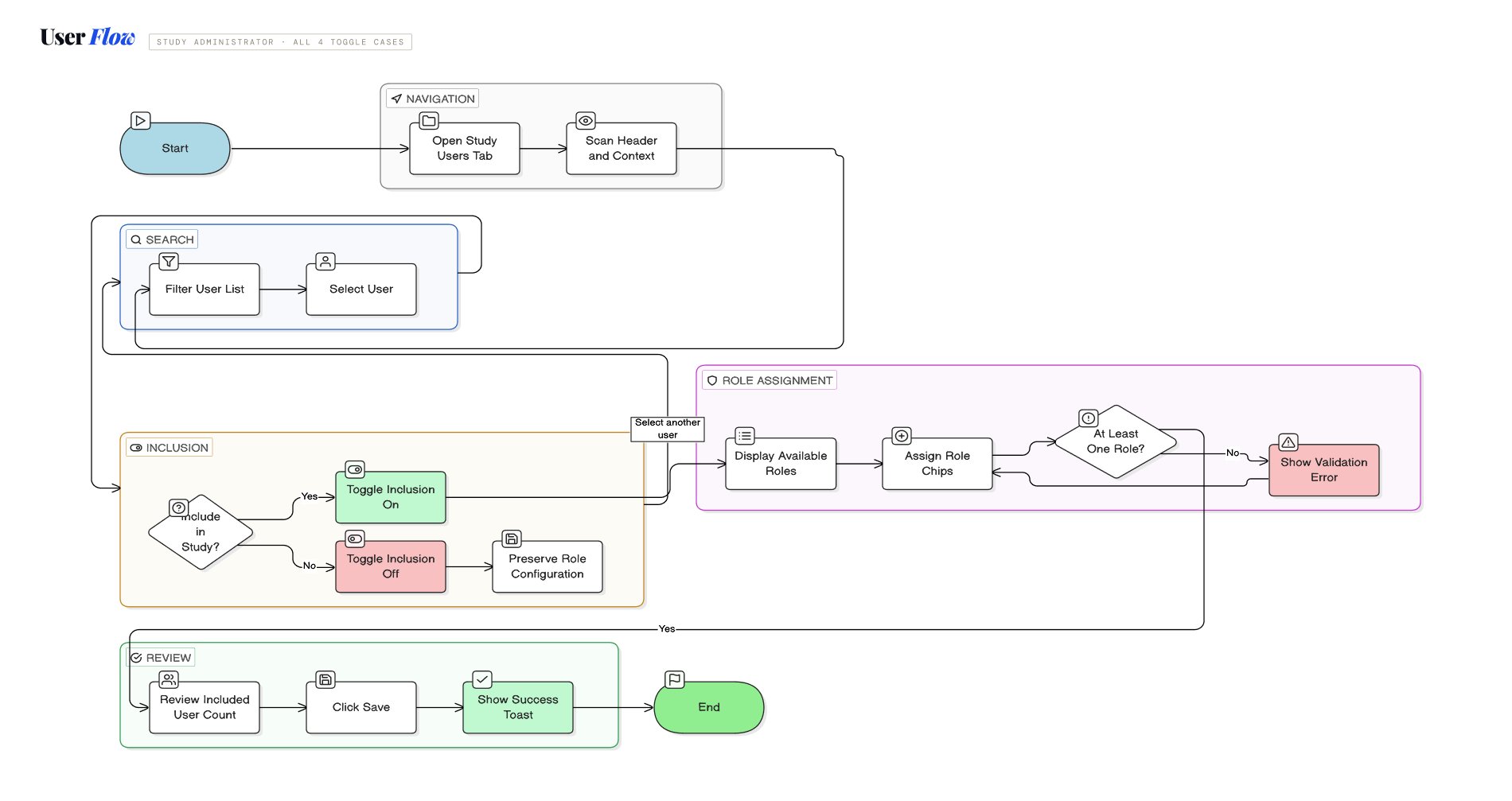
Case 01 · Default
User not in the study. Roles hidden. Dropdown disabled. Placeholder: "Turn on Include in Study to assign roles."
Case 02 · Active
User included. Default roles appear as chips, added or removed inline.
Target state for most adminsCase 03 · Reversal
User removed. Roles hidden, not deleted. Toggle back on and they reappear.
The critical trust fixCase 04 · Validation
User stays included but Save is blocked. Inline: "Select at least one role to include the user."
Prevents invalid stateProcess
Three artefacts.
Before any UI.
The interface came last. First the team had to agree on what the system should do, and what it must never do.
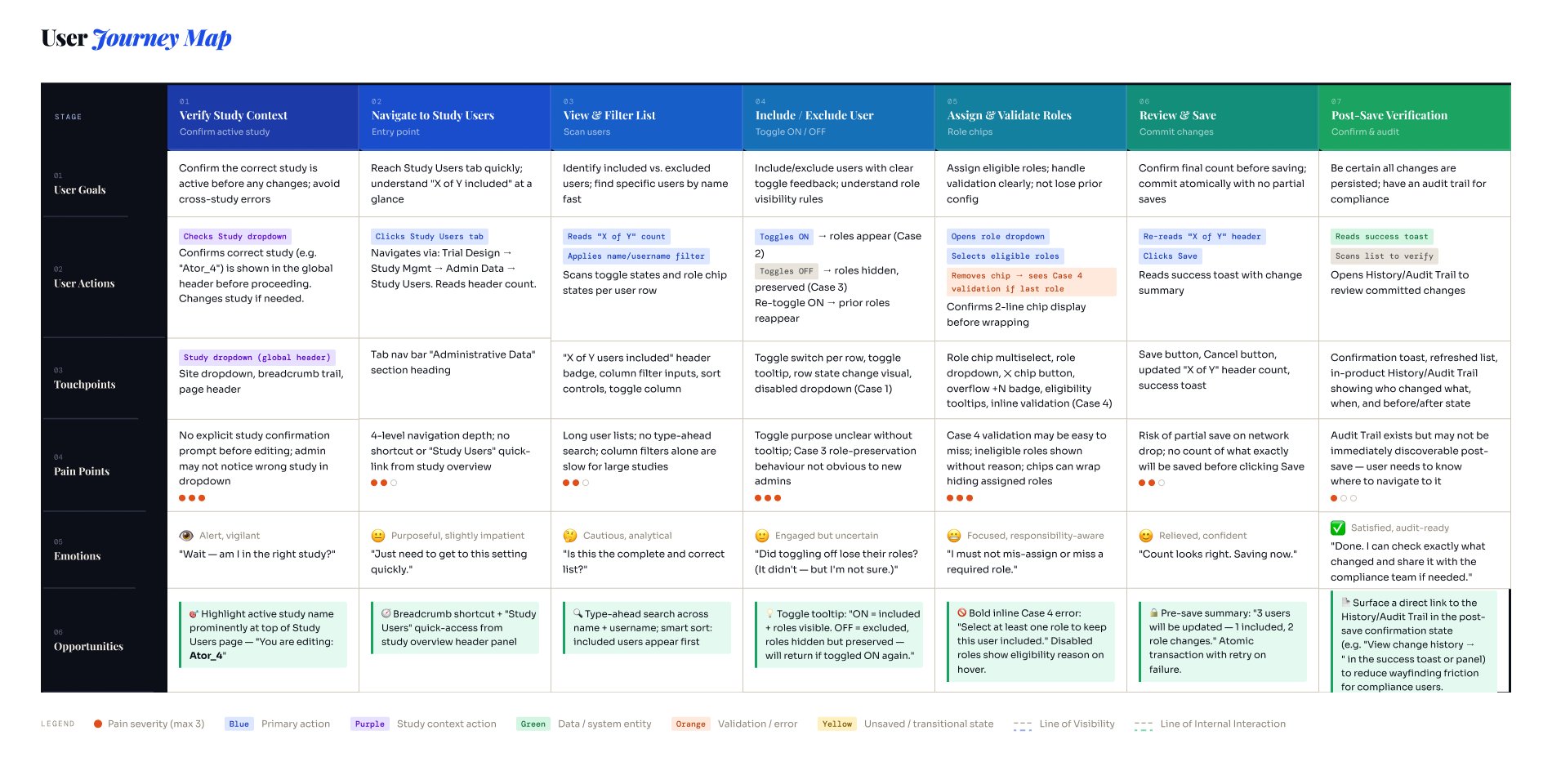
- Journey map. Seven stages across the task, which surfaced study context verification as the riskiest moment
- User flow. All four toggle cases with explicit decision gates, which made Case 3 and Case 4 first class states rather than edge cases
- Service blueprint. Aligned role persistence with the atomic save transaction, and engineering confirmed it before a pixel moved
Impact
What changed.
Efficiency
Bulk inline editing replaced the one user modal flow. An estimated 50 to 70% fewer task steps for multi user scenarios.
Trust
Roles preserved on toggle-off. Admins stopped avoiding the toggle. Support tickets about accidental role loss dropped post-release.
Clarity
Clear included vs excluded state. "X of Y" count in header. Study access status visible at a glance.
Safety
Case 4 blocks saving a user with no roles. The save is atomic, so changes commit together or not at all.
Scalability
More users, more roles, larger study configurations. The pattern was reused across other admin modules.
Reflection
What it actually was.
Came in as a UI cleanup request. Turned out to be three things:
- A state management problem. Toggle behaviour had to be predictable, reversible, and confirmed by the backend
- A trust problem. Admins avoided a control because they didn't know what it would do
- A system alignment problem. UX, Product, and Engineering needed shared definitions before any code was written
Reversibility builds trust in enterprise systems faster than visual polish
State clarity reduces cognitive load more than interface changes
Service blueprints make backend behaviour a shared responsibility
System thinking is how you get from "fix the UI" to "fix the thing that matters"
The real work wasn't designing the interface. It was defining behaviour people could rely on.